 By Miles Sinclair
Updated November 2026
Early season track workouts for distance runners need to build speed and rhythm without pushing you into injury before the racing calendar gets serious. The picks below were chosen by checking product listings, publisher reputation and the kinds of feedback owners tend to leave, with a focus on whether each book or logbook gives you usable session structure for the first weeks on the track.
Best overall: Track & Field Coach Workout & Meet Logbook – View on Amazon
Best for structured training plans: Hal Higdon’s How to Train – View on Amazon
Best for cross country crossover: 101 Developmental Concepts & Workouts for Cross Country Runners – View on Amazon
Best for binder-style session planning: Run Workouts for Runners and Triathletes – View on Amazon
Our Top Picks
| Product | Best for | Key feature |
|---|---|---|
| Track & Field Coach Workout & Meet Logbook | Logging early season sessions | Season planner, 110 pages |
| Hal Higdon’s How to Train | Phased training structure | Programs for all ages |
| 101 Developmental Concepts & Workouts for Cross Country Runners | Cross country speed sessions | 101 workouts in one place |
| Run Workouts for Runners and Triathletes | Modular session planning | Binder-based workout cards |
Track & Field Coach Workout & Meet Logbook

Track & Field Coach Workout & Meet Logbook : A Complete Season Planner for Sprints, Distance, Jumps, Throws, Conditioning, and Track Meet Results — 8.5×11, 110 Pages
Best for: Logging early season sessions and tracking progress across sprints and distance work.
This logbook suits coaches and athletes who want one place to plan the season, record interval splits and note meet results. Owners often report that the 8.5×11 format leaves enough room to write out full workouts.
Pros
- Season planner layout covers conditioning as well as track sessions.
- Space for meet results keeps early season data in one spot.
Cons
- It is a logbook, so you need to write your own workouts.
Hal Higdon’s How to Train

Hal Higdon's How to Train: The Best Programs, Workouts, And Schedules For Runners Of All Ages
Best for: Phased training structure that builds from base work into faster track sessions. A related read: 4 Best Basketball Track Conditioning Workouts (2026): Our Picks.
This book fits runners who prefer a published program with set weeks and paces rather than building sessions from scratch. Readers frequently mention the clear progression from easier running into interval work.
Pros
- Programs are organized by week, which makes early season planning simple.
- Covers runners across many experience levels.
Cons
- Plans are general, so you may need to adjust for track-specific speed.
101 Developmental Concepts & Workouts for Cross Country Runners
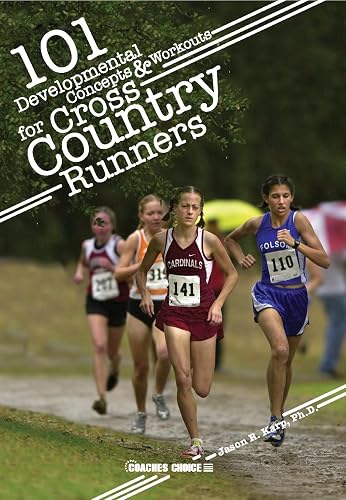
101 Developmental Concepts & Workouts for Cross Country Runners
Best for: Cross country speed sessions that carry over to the track.
This title suits coaches and distance runners who want a large bank of workouts to rotate through early in the season. Its focus on developmental concepts gives useful context for why each session exists.
Pros
- A wide menu of workouts reduces repetition across weeks.
- Explains the purpose behind each session type.
Cons
- Written with cross country in mind, so track distances may need adapting.
Run Workouts for Runners and Triathletes

Run Workouts for Runners and Triathletes (Workouts in a Binder Series)
Best for: Modular session planning you can mix and match across the early season.
This binder-style resource suits runners who like to pull individual workout cards and combine them into a weekly schedule. It works well for building variety into interval blocks.
Pros
- Workouts are separated, so you can build custom weeks.
- Useful for triathletes and runners alike.
Cons
- Less detailed narrative guidance than a full training book.
Buying Guide
Session Variety
Early season work should mix short speed repeats, tempo blocks and easy days. Look for a resource with enough different workouts that you do not repeat the same session every week.
Structure and Progression
A good early season resource shows how volume and intensity rise over several weeks. Phased plans help you avoid adding too much speed too soon.
Logging Space
Recording splits, rest intervals and how you felt makes it easier to adjust your training. Make sure the format has room for the details you want to track.
Event Focus
Track and cross country workouts overlap but are not identical. Choose a resource that matches the distances you race most.
Good picks for this: Hal Higdon’s How to Train and Track & Field Coach Workout & Meet Logbook
FAQ
How long should early season track workouts last?
Most early season sessions run 30 to 60 minutes including warm-up and cooldown. Keep the hard portion short at first and build from there.
How many track sessions per week should distance runners do early on?
Many coaches suggest one or two quality sessions per week in the early season, with easy running in between. Adjust based on recovery and any past injury history.
Should I see a professional before starting track workouts?
If you are returning from injury or have a health condition, consult a doctor or qualified coach before increasing intensity.
Conclusion
For a complete season plan, Hal Higdon’s How to Train gives the clearest structure, while the Track & Field Coach Workout & Meet Logbook is best if you want to record your own progress. Runners focused on cross country crossover should look at the developmental concepts book, and those who like building weeks from individual cards will find the binder-style resource most useful.
Sources
- Physical activity guidelines and recommendations for adults (cdc.gov)
- Position guidance on exercise prescription and progression (acsm.org)
- Research on training load and recovery in endurance athletes (nih.gov)
Related reading
- 3 Best Track Workouts for Mid Distance Runners (2026)
- 3 Best Track Workouts for Distance Runners: Picks Compared (2026)
- 4 Best Track Workouts for 400 Meter Runners (2026)
About Miles Sinclair
Miles Sinclair is part of our editorial team and reviews and edits our speed & interval running guides, checking product details against manufacturer specifications and owner feedback.