
 By Owen Palmer
Updated November 2026
Choosing a high intensity interval training HIIT treadmill is less about finding the fastest machine and more about finding one that can handle sudden speed changes, steep inclines and repeated hard efforts without feeling unstable or wearing you down. This list compares seven home treadmills that manufacturers position for interval-style training. Our selection criteria were motor power and top speed, incline range, deck size and cushioning, weight capacity, the presence of preset interval or HIIT programs, and the general patterns that owners report about build quality and noise. None of this is based on our own testing; we relied on published specifications and recurring owner feedback.
Our top picks at a glance
- 1
 TOP CHOICEBest overall18-Inch Wide Running Belt 3.0 HP Incline TreadmillView on Amazon
- 2
 TOP CHOICEBest for small spacesTreadmill with Speaker, 6-in-1 Foldable Treadmill for HomeView on Amazon
- 3
 TOP CHOICEBest budget pickFull-Size Curved Manual Treadmill (Self-Powered)View on Amazon
- 4
 Best for joint comfortProForm Carbon Foldable TreadmillView on Amazon
- 5
 Best for connected trainingNordicTrack T Series TreadmillView on Amazon
- 6
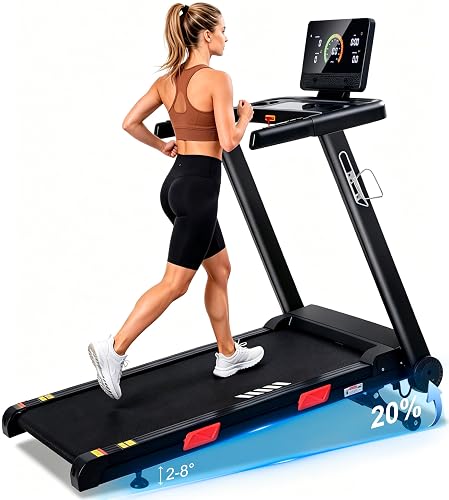 Best for automatic incline changes20% Auto Incline Shock-Absorbing TreadmillView on Amazon
- 7
 Best for steep hill intervalsCURSOR 40% Incline Treadmill with Stair SimulationView on Amazon
Our Top Picks
Quick Comparison
| Product | Best for | Key feature |
|---|---|---|
| 18-Inch Wide Running Belt 3.0 HP Incline Treadmill | Overall home HIIT | 15% auto incline, 10 MPH top speed |
| Treadmill with Speaker, 6-in-1 Foldable Treadmill | Small spaces | 12 HIIT programs, 10% incline |
| Full-Size Curved Manual Treadmill | Budget-minded sprint work | No electricity needed, 8 resistance levels |
| ProForm Carbon Foldable Treadmill | Joint-friendly running | Shock-absorbing cushioning |
| NordicTrack T Series Treadmill | Guided and connected workouts | Multiple models in the series |
| 20% Auto Incline Shock-Absorbing Treadmill | Hill intervals | 20% auto incline, 36 preset programs |
| CURSOR 40% Incline Treadmill | Steep incline and stair work | 40% incline, stair simulation mode |
18-Inch Wide Running Belt 3.0 HP Incline Treadmill
18-Inch Wide Running Belt; 3.0 HP Incline Treadmill; 10 MPH Speed, 36 Preset Programs; Joint-Friendly Cushioning Treadmills for Home, 15% Auto Incline, Foldable, 350LB Capacity
Best for: Overall home high intensity interval training on a treadmill
This is a well-rounded choice for runners who want room to sprint and a motor strong enough for repeated speed changes. The wide belt and cushioning suit people who plan to run hard intervals several times a week.
Key specs
- 18-inch wide running belt
- 3.0 HP motor
- Top speed of 10 MPH
- 15% auto incline
- 36 preset programs
- 350 lb weight capacity
- Foldable frame
Pros
- Top speed is enough for serious sprint intervals
- Wide belt gives comfortable footing at high speed
- Preset programs reduce setup time between sets
Cons
- Footprint is large when unfolded
- Owners sometimes mention that the console takes practice to navigate
Bottom line: A strong first pick for someone who wants one treadmill that handles both steady running and demanding HIIT sessions.
Treadmill with Speaker, 6-in-1 Foldable Treadmill for Home
Treadmill with Speaker, 6-in-1 7.5MPH Foldable Treadmill for Home with App Compatible, Walking Pad with 10% Incline, LED Display, 3.0HP Brushless Drive, 350 LB Weight Capacity, 12 HIIT Programs
Best for: Small spaces and varied workouts
Designed for people who need to store the machine out of the way. Its multiple modes make it useful for walking, light jogging and short interval blocks.
Key specs
- Top speed of 7.5 MPH
- 10% incline
- 3.0 HP brushless drive
- 12 HIIT programs
- 350 lb weight capacity
- LED display and app compatibility
Pros
- Folds down for storage between sessions
- Multiple programs suit different fitness levels
- Built-in speaker keeps workouts engaging
Cons
- Lower top speed limits all-out sprint intervals
- Smaller deck may feel tight for long strides
Bottom line: Best for people who value flexibility and storage over maximum speed.
Full-Size Curved Manual Treadmill (Self-Powered)
90% pre-assembled,ull-size self-powered design for HIIT, sprint intervals and home gyms; 78.74" x 35.43" running area Curved Manual Treadmill, 8 Resistance Levels, Non-Electric
Best for: Budget-minded sprint work without an electrical outlet
A non-electric curved belt is driven by the user’s own motion. Many owners say it feels more like outdoor sprinting than a motorized belt, though it requires more effort to start and maintain speed.
Key specs
- Running area of 78.74 x 35.43 inches
- Non-electric, self-powered design
- 8 resistance levels
- Ships mostly pre-assembled
Pros
- No motor means no electricity cost
- Large running surface suits full strides
- Good for building explosive sprint power
Cons
- Not suitable for walking or beginners who need controlled speed
- No automatic incline or preset programs
Bottom line: A good fit for experienced runners who want intense sprint intervals and do not need automation.
ProForm Carbon Foldable Treadmill
Foldable Treadmill for Running and Cardio Workouts with Shock Absorbing Cushioning to Reduce Joint Impact ProForm Carbon Treadmills
Best for: Joint-friendly running and cardio intervals
This model focuses on cushioning, which matters when interval sessions involve repeated hard landings. It suits runners who want to protect knees and shins during frequent speed changes.
Key specs
- Foldable frame
- Shock-absorbing deck cushioning
- Designed for running and cardio workouts
Pros
- Cushioning is a key consideration for joint comfort
- Folding design saves floor space
- Suitable for both walking and running intervals
Cons
- Exact motor and speed specs vary by configuration, so check the listing
- Owners sometimes report that the deck feels softer at high speeds
Bottom line: Suited to runners who prioritize cushioning over outright power.
NordicTrack T Series Treadmill
NordicTrack T Series Treadmills for Home | T5, T6.5s, T7, T10, T16
Best for: Guided and connected interval training
The T Series covers several models, so features vary by version. Its appeal is the integration with guided workout content, which can take the planning out of structured intervals.
Key specs
- Available in multiple models (T5, T6.5s, T7, T10, T16)
- Designed for home use with guided training features
Pros
- Series offers options at different feature levels
- Guided workouts help with pacing and interval structure
- Well-known brand with broad owner support resources
Cons
- Some features depend on subscription content, which may not suit everyone
- Higher-tier models take up significant floor space
Bottom line: A strong choice for people who want structure and coaching built into the machine.
20% Auto Incline Shock-Absorbing Treadmill
20% Auto Incline, 18.5" Wide Belt, 350 lbs Capacity, 36 preset programs, Bluetooth App, Shock-absorbing Treadmill with Auto Incline, 3.0HP, 10 MPH Speed Running Machine
Best for: Hill intervals and automatic incline changes
Automatic incline shifts make it easier to run hill repeats without touching the console mid-set. This suits runners who want to train for hilly races.
Key specs
- 20% auto incline
- 18.5-inch wide belt
- 350 lb capacity
- 36 preset programs
- 3.0 HP motor, 10 MPH top speed
- Bluetooth app connectivity
Pros
- Steep auto incline supports hill intervals
- Wide belt and shock absorption aid comfort
- Bluetooth app supports tracking
Cons
- Steep incline can be demanding for newer runners
- Assembly may take longer than with simpler models
Bottom line: Best for runners who want hill-focused intervals with minimal manual adjustment.
CURSOR 40% Incline Treadmill with Stair Simulation
Stair Simulation Mode, LED Display, 3.0HP Quiet Brushless Treadmill , 7-Layer Shock Absorption, 350LBS Capacity CURSOR 40% Incline Treadmill with 15" Deck Height & Extended Handle Bar
Best for: Steep incline and stair-climbing intervals
The very high incline range and stair simulation mode target climbing-focused training. Owners often use it for strength-endurance work alongside running.
Key specs
- 40% incline range
- Stair simulation mode
- 3.0 HP quiet brushless motor
- 7-layer shock absorption
- 350 lb capacity
- 15-inch deck height
Pros
- Extreme incline builds hill and climbing strength
- Stair mode adds variety
- Quiet motor suits shared living spaces
Cons
- Very steep settings are not suited to beginners
- Higher deck height may feel unusual for some users
Bottom line: A specialized pick for people who want climbing-focused HIIT more than flat-ground sprinting.
Buying Guide
Motor Power and Top Speed
For HIIT, the motor needs to accelerate quickly and hold speed without strain. Manufacturers often list continuous horsepower (CHP) and peak horsepower; continuous ratings are the more useful number. A top speed of around 10 MPH gives room for all-out sprint intervals for most runners.
Good picks for this: 18-Inch Wide Running Belt 3.0 HP Incline Treadmill, 20% Auto Incline Shock-Absorbing Treadmill
Incline Range and Adjustment Method
Incline changes add a different training stimulus than speed alone. Consider whether you want gentle grades of about 10 percent or steep settings up to 40 percent. Automatic incline adjustment lets you focus on effort rather than the console.
Good picks for this: 20% Auto Incline Shock-Absorbing Treadmill, CURSOR 40% Incline Treadmill with Stair Simulation
Deck Size and Belt Width
Interval sprints demand a longer, wider running surface. A belt around 18 inches wide is generally more comfortable at high speed than narrower decks. Check the running area length as well, since a short deck can feel cramped on full strides.
Good picks for this: 18-Inch Wide Running Belt 3.0 HP Incline Treadmill, Full-Size Curved Manual Treadmill
Cushioning and Joint Impact
Repeated sprints increase impact through the knees, hips and shins. Shock-absorbing decks reduce some of this load, though they do not eliminate it. If you have existing joint issues, talk with a physical therapist or doctor before starting a high-intensity program.
Good picks for this: ProForm Carbon Foldable Treadmill, 20% Auto Incline Shock-Absorbing Treadmill
Preset Programs and Interval Features
Built-in HIIT programs save time and make it easier to follow consistent work-to-rest ratios. Look for models that let you set custom intervals as well as preset ones, so you can progress over time.
Good picks for this: Treadmill with Speaker 6-in-1 Foldable Treadmill, NordicTrack T Series Treadmill
Footprint, Folding and Storage
Measure your space before you buy. Folding models save room but may have a smaller deck. Remember to allow clearance around the machine for safe stepping on and off, especially during sprints.
Good picks for this: Treadmill with Speaker 6-in-1 Foldable Treadmill, ProForm Carbon Foldable Treadmill
Weight Capacity and Durability
Check the user weight limit, which is often around 350 pounds on home models. Frame stability matters more during intense intervals than during steady walking. Owners frequently cite stability and noise levels as key long-term concerns, so read recent owner feedback.
Good picks for this: CURSOR 40% Incline Treadmill with Stair Simulation, 18-Inch Wide Running Belt 3.0 HP Incline Treadmill
FAQ
Is a treadmill good for HIIT?
Yes. A treadmill lets you control speed and incline precisely, which makes it practical for sprint intervals and hill repeats. Just make sure the machine has enough motor power and a belt wide enough for full-speed efforts.
What speed should I use for HIIT on a treadmill?
Work intervals should feel hard, usually near your maximum sustainable effort for 20 to 60 seconds. Recovery intervals can be walking or slow jogging. Beginners often start with lower speeds and shorter work periods.
How long should a treadmill HIIT workout last?
Many people complete effective sessions in 15 to 30 minutes, including a warm-up and cool-down. Frequency depends on recovery and experience, so start with one or two sessions per week.
Do I need an incline for HIIT?
Not necessarily. Speed intervals alone are effective. Incline adds variety and can increase effort, so it is useful once you are comfortable with flat sprints.
Is a manual treadmill better than a motorized one for intervals?
Manual treadmills require more effort to start and maintain speed, which can build strong sprint power. Motorized models are easier for beginners and offer more precise speed control. Neither is universally better.
Can HIIT on a treadmill hurt my joints?
High-impact running can stress joints, especially with repeated sprints. Cushioned decks help, and proper footwear matters too. If you have joint pain, consult a doctor or physical therapist before starting.
How often should I do treadmill HIIT?
Most people benefit from two to three sessions per week with rest days in between. Overdoing intervals can lead to fatigue and injury, so listen to your body.
Conclusion
For most home users, the 18-Inch Wide Running Belt 3.0 HP Incline Treadmill offers the most balanced mix of speed, incline and comfort. Choose the 6-in-1 Foldable Treadmill if space is tight, the curved manual treadmill if you want intense sprint work without electricity, and the 20% Auto Incline model if hill intervals are your priority. The CURSOR 40% Incline Treadmill suits climbing-focused training, while the ProForm Carbon emphasizes cushioning and the NordicTrack T Series suits people who want guided workouts. Match the machine to your space, goals and joint comfort rather than chasing the highest spec sheet.
Sources
- Guidance on physical activity recommendations and how vigorous exercise fits into weekly goals (cdc.gov)
- Home fitness equipment safety information and recall notices (cpsc.gov)
- Position statements and resources on exercise prescription and interval training (acsm.org)
Related reading
- High Intensity Interval Training HIIT for Men: 7 Best Picks Compared (2026)
- High Intensity Interval Training HIIT at Home: A Step-by-Step Guide
- Rowing High Intensity Interval Training: 8 Best Books and Guides (2026)
About Owen Palmer
Owen Palmer is part of our editorial team and reviews and edits our speed & interval running guides, checking product details against manufacturer specifications and owner feedback.
