
 By Miles Sinclair
Updated November 2026
Coaches and parents searching for free middle school track workouts usually want something they can use right away: clear sessions, age-appropriate volume, and enough structure to run a practice without guessing. The six options below were selected from product listings, publisher descriptions, and common owner feedback patterns, with a focus on workouts that suit younger athletes and beginner coaches. Each pick is judged on how specific its sessions are, how well it fits a middle school setting, and how easy it is to adapt.
Best overall: Track and Field Journal With Workouts – View on Amazon
Best for beginner coaches: Coaching Middle School Cross Country and Track & Field – View on Amazon
Best for 400m focus: The 400 Meter Workout – View on Amazon
Best for small programs: The 45 Minute Workout for Small High Schools & Middle School Track & Field Programs – View on Amazon
Best for sprint sessions: Just The Track Workouts – View on Amazon
Best for younger kids: Kids Fitness Exercises – View on Amazon
Our Top Picks
Quick Comparison
| Product | Best for | Key feature |
|---|---|---|
| Track and Field Journal With Workouts | Multi-event training logs | Strength, throws, jumping circuits |
| Coaching Middle School Cross Country and Track & Field | Beginner coaches | Sample workouts and guidance |
| The 400 Meter Workout | 400m specialists | Advanced 400m session design |
| The 45 Minute Workout for Small High Schools & Middle School Track & Field Programs | Small programs | Time-efficient practice plans |
| Just The Track Workouts | Sprint and interval sessions | Focused track session list |
| Kids Fitness Exercises | Younger athletes | 28 days with QR videos |
Track and Field Journal With Workouts

Track and Field Journal With Workouts: General Strength, Multi Throws, Jumping Circuits
Best for: Multi-event training logs
This suits coaches who want a single resource covering several event groups and a place to record results.
Pros
- Covers general strength, multi throws, and jumping circuits
- Doubles as a log for tracking progress across a season
Cons
- Less depth for any one event group
Coaching Middle School Cross Country and Track & Field

Coaching Middle School Cross Country and Track & Field: Practical Guidance and Sample Workouts for Beginner Coaches
Best for: Beginner coaches
A practical starting point for first-year coaches who need guidance on running a middle school program and sample sessions to build from.
Pros
- Explains practical coaching decisions for younger athletes
- Includes sample workouts that are easy to adapt
Cons
- Broader coaching focus than a workout-only collection
The 400 Meter Workout

The 400 Meter Workout: Advanced Training For 400 Meter Sprinters
Best for: 400m focus
Best suited to athletes already comfortable with interval work who want structured 400m sessions.
Pros
- Specific pacing and rep structure for the 400m
- Clear progression across sessions
Cons
- Written at an advanced level, so younger athletes may need scaling
The 45 Minute Workout for Small High Schools & Middle School Track & Field Programs
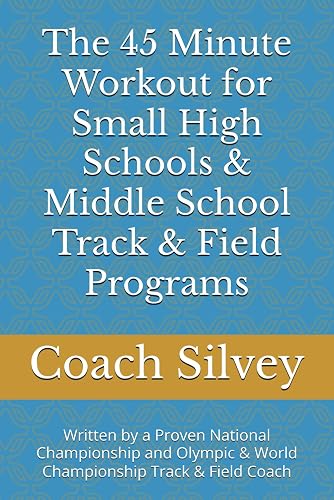
The 45 Minute Workout for Small High Schools & Middle School Track & Field Programs: Written by a Proven National Championship and Olympic & World Championship Track & Field Coach
Best for: Small programs
Aimed at coaches with limited practice time who need efficient sessions that cover a full group.
Pros
- Built around a 45-minute practice window
- Suits programs with mixed event groups
Cons
- Session length may feel tight for larger squads
Just The Track Workouts

Just The Track Workouts
Best for: Sprint and interval sessions
A straightforward option for coaches who want a focused list of track sessions without extra material.
Pros
- Concentrated on track session design
- Easy to scan before practice
Cons
- Limited guidance on warm-ups and recovery
Kids Fitness Exercises

Kids Fitness Exercises: “28 Days of Fun Kids’ Workouts with QR Code Videos for Homeschool, PE, and Family Fitness”
Best for: Younger athletes
Useful for lighter conditioning and fun-first sessions, especially for athletes new to organized fitness. You may also like Core Workouts for Track Athletes: 5 Best Picks for Strength and Speed (2026).
Pros
- Short, age-friendly exercise format
- Includes QR code videos for demonstration
Cons
- Not built specifically around track events
Buying Guide
Match the session to the athlete’s age and experience
Middle schoolers need lower volume and more variety than high school sprinters. Look for workouts that scale in rep count and rest rather than assuming one intensity fits everyone. If you want more background, see Pool Workouts for Track and Field Athletes: 6 Best Picks for 2026.
Check whether the workouts cover your event groups
A program with sprinters, jumpers, and distance runners needs sessions for each. Multi-event resources save time, while specialist guides give more depth for one group. 6 Best Modified Track and Field Workouts for Coaches and Athletes (2026) goes further into this.
Look for clear pacing and rest guidance
Interval sessions only work when rest periods are defined. Prefer resources that list distances, paces or effort levels, and recovery between reps. For another angle, check out 6 Best Indoor Track Workouts for High School Athletes (2026).
Consider how you will use it in practice
A printable or easy-to-scan layout helps during warm-ups. Some coaches prefer a journal format for logging results across a season.
Good picks for this: Track and Field Journal With Workouts and Coaching Middle School Cross Country and Track & Field
FAQ
Are these workouts really free to use?
The workouts described here are offered as part of published products, so the sessions themselves are not free in the way the title suggests. Coaches looking for truly no-cost options can start with the free sample workouts many coaching resources publish online and use the books below to build a fuller plan.
What age range are these workouts designed for?
Most of these options focus on middle school athletes, typically around ages 11 to 14, though some sessions can be scaled up or down. Coaches should still check each workout’s volume and intensity against the experience level of their own athletes. Younger or newer runners generally need shorter reps and longer recovery.
Do I need prior coaching experience to use these plans?
Not necessarily, but some options are written with beginner coaches in mind and include practical guidance on running a practice. Coaches with more experience may prefer the more specialized sprint or event-focused workouts. Either way, it helps to review the pacing and rest notes before the first session.
Can these workouts be used for cross country as well as track?
Some of the options cover cross country alongside track and field, while others focus only on sprints, throws, or jumps. If your program runs both seasons, look for a resource that includes endurance sessions. Mixing sessions from two different sources is also a common approach.
How often should middle school athletes train with these workouts?
Middle school athletes generally benefit from two to four structured sessions per week, with adequate rest days in between. Workouts should emphasize skill, fun, and gradual progression rather than heavy volume. Adjust frequency based on your season, school schedule, and how athletes are recovering.
Should parents use these resources at home?
Parents can use the general fitness and kids-focused options to support activity at home, especially for younger children. Track-specific sessions are best run under supervision, particularly for sprints and jumps where technique and safety matter. Always encourage athletes to warm up properly and stop if they feel pain.
Conclusion
Coaches who need a complete, ready-to-run practice plan for a middle school team will get the most value from the more structured journals and coaching guides. Those who want focused sessions for a specific event, such as sprinting or throws, should look at the event-specific workouts, while parents and homeschool families may prefer the kids-oriented fitness option.
Whichever you choose, start with the athletes’ age and experience, check that the workouts match your event groups, and follow the pacing and rest guidance closely. A well-chosen plan used consistently will do far more for young athletes than an ambitious one that is too hard to sustain.
Related reading
- Middle School Track Workouts PDF: 5 Printable Sessions for Coaches and Athletes
- Middle School Track Workouts Download: 6 Printable Sessions for Speed (2026)
- 3 Best Sprint Workouts for Middle School Track: Our Picks Compared
- Fun Track Workouts for High School: 3 Best Picks for Coaches and Athletes
About Miles Sinclair
Miles Sinclair is part of our editorial team and reviews and edits our speed & interval running guides, checking product details against manufacturer specifications and owner feedback.
